

The composition and function of vacuum blister machine
1. Clamping equipment
When the plastic sheet is formed, the sheet is fixed on a clamping device. Clamping devices that facilitate the fixation of sheets of various sizes are often used on general-purpose and composite thermoforming machines. Some have the entire molding machine equipped with a clamping frame.
Clamping devices can be divided into two categories: one is frame type and the other is split type. The frame clamping device consists of upper and lower frames. The sheet is sandwiched between two frames. When the frame is open, the lower frame generally remains fixed. The lower part of the upper frame of various types of single-station molding machines is directly fixed on the molding chamber. Manual and semi-automatic molding machines for loading parisons and removing finished products by hand, when the frame size is large, are equipped with safety operating devices within the frame opening range. For parisons with large slippage during molding, the clamping force is required to be adjusted within a relatively wide range. To this end, two rubber-coated rollers are used to press each other with springs and are equipped with a pressure adjustment device. The clamping of the continuous pull tab forming machine is the joint action of the zippers on both sides and the front and rear gates.
It is best to use automatic control for the clamping device so that it can act quickly and help improve the quality and efficiency of the parts.
2. Heating equipment
One of the main processes in the vacuum molding process of thermoplastic sheets and films is sheet heating. The duration and quality of electric heating depend on the structure of the heater, the thermal inertia of temperature heat transfer behind the radiating surface, the distance between the sheet and the heater, the radiant energy absorption coefficient, the characteristics of the heater surface and the thermophysical properties of the material. Commonly used heaters include electric heaters, crystal radiators and infrared heaters.
3. Vacuum equipment
The vacuum system consists of a vacuum pump, a gas tank, valves, pipelines, and a vacuum meter. In vacuum forming, a separate vacuum pump is often used. The vacuum degree of this pump should reach 0.07~0.09 Mpa (520mmHg) or above. The gas storage tank is generally a cylindrical box welded with thin steel plates, with an oval bottom. The capacity of the gas tank should be at least half greater than the capacity of the largest molding chamber. On the vacuum line, appropriate valves must be installed to control the narrow vacuum capacity.
The rotation power of the vacuum pump is determined by the size and molding speed of the molding equipment. Larger or faster molding speed equipment is commonly used as large as 2-4KW. The size of the vacuum central system depends on the specific production and development requirements of the factory.
4. Compressed air equipment
The pneumatic system can be composed of the molding machine itself with a compressor, a gas storage tank, a workshop main pipeline set, valves, etc. The molding machine requires compressed air with a pressure of 0.4-0.5MPa, and piston air compressors are widely used in various vacuum molding machines. Large screw air compressors can also be supplied from the whole factory.
In addition to a large amount of compressed air being used for molding, a part of it is used for demoulding, external cooling of the primary product, and power to control the movements of the mold frame and running sheets.
5. Cooling equipment
In order to improve production efficiency, vacuum molded products often need to be cooled before demoulding. Ideally, both the inner and outer surfaces of the part in contact with the mold are cooled, and it is best to use a mold with a built-in cooling coil. For non-metal molds, such as wood, gypsum, glass fiber reinforced plastics, epoxy resin and other molds, since they cannot be cooled by water, air cooling can be used instead, and additional water mist can be added to cool the outer surface of the vacuum blister molding parts.
If natural cooling is used during production, annealed parts can be obtained, which is beneficial to improving the impact resistance of the parts. Although water cooling has high production efficiency, the internal stress of the parts is relatively large.
6. Demolding equipment
Demolding is to move the product out of the mold, usually whether it is a concave mold or a male mold. In most cases, the product is close to the mold due to cooling and shrinkage, so it is demolded through a vacuum suction hole or blowing in the opposite direction.
Especially for molds with small demoulding slopes or molds with concave molds, the demoulding mechanism is used to push or vibrate the mold at the same time. Sometimes a release agent is applied to the sheet and the mold or the surface of the mold is sprayed with Teflon.
7. Blister machine control equipment
The control system generally includes the control of various parameters and actions of instruments, meters, pipes, and valves during vacuum blister molding, finishing, and other processes. Control methods include manual, electrical-mechanical automatic control, computer control, etc. The specific selection should be comprehensively considered based on the initial investment in labor costs, technical requirements, raw material costs, production and maintenance equipment costs and other factors.
HUATAO provides blow molding equipment. Including:
Plastic Mold Equipment
Automatic Blow Molding Machine
Semi-automatic Blow Molding Machine
PS Foaming Machine
EPE Foaming Machine
PU Foaming Molded Machine
Horizontal lnjection Molding Machine
vertical lnjection Molding Machine
All-electric Injection Molding Machine
Thick Sheet Blister Machine
Thin Sheet Blister Machine
Color Plastic Masterbatch
Plastic Recycle Machine
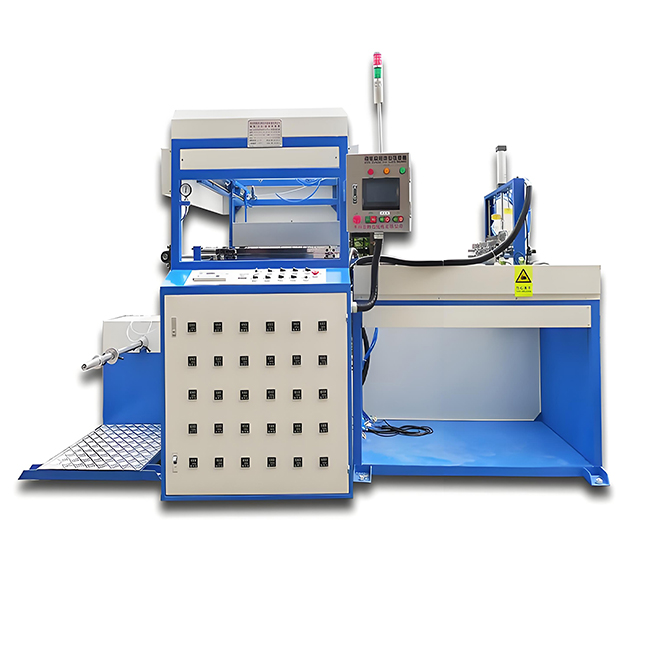
Whether you need help with equipment selection, process optimization, or design customization, our team can help. We have the expertise and knowledge to analyze your project needs, identify challenges and develop innovative solutions.