

Analyze the application scope of fully automatic blister machines in buses
With the rapid development of transportation networks, the demand for passenger cars continues to grow, and the requirements for the safety and comfort of passenger cars are also constantly increasing. The beauty and luxury of interior parts have become one of the important symbols of high-end luxury buses.
Interior parts mainly refer to plastic parts, and their molding processes include injection molding, blister molding, blow molding, extrusion, etc. Injection molding has high production efficiency, high precision of molded products, and can mold complex parts. However, the mold investment cost is high, product updates are slow, and the size of the parts is limited by the specifications of the molding machine. Therefore, the main application of injection molding in buses is instrument panels. , air conditioning outlets and other complex parts as well as parts that require precise fit. Fully automatic blister machines have low mold investment costs, are suitable for the production of large-size parts, and are suitable for products that can be replaced quickly, but the dimensional accuracy is not high and the production efficiency is low. Since the passenger car interior is mainly made of large covering parts, the accuracy requirements are not high, and the output of the bus itself is not high. One model is generally produced around a few hundred units per year. In addition, customers often put forward various requirements for the interior configuration of the car. The size and appearance of parts change more or less, so the blister process is often used in the interior parts of passenger cars. Blow molding and extrusion molding both produce plastic parts with specific requirements, and their scope of application is limited in the field of passenger car interiors.
Fully automatic blister machines can be divided into two types according to technology: sheet blister and soft skin blister. The material used for blister is mainly acrylonitrile-butadiene-styrene (ABS) sheet, and a small number of parts are made of organic glass (PMMA) sheet. The inner panels on the left and right sides of the passenger cab, the top inner panel, the rear inner panel, and some electrical box covers and other covers are all made of ABS sheets. There is also a trend now to use composite ABS boards to replace ordinary ABS boards. Composite ABS boards add a layer of foamed polypropylene or polyvinyl chloride material to the board, and roll them together into a board with leather texture or feel like real leather. The sound cover of the instrument panel that requires transparency, and the breathable grille outside the car body that requires anti-aging are generally made of organic glass. The soft skin blister process is mainly used on passenger car dashboards. The base body is usually fiberglass (FRP), and air suction holes are opened on the FRP to absorb the skin. The skin materials are mainly polyvinyl chloride plus foamed polypropylene (PVC/ PPF) composite material.
Blister molds are divided into three types: steel molds, fiberglass molds, and wood molds. Steel molds have a long life and can produce more than 10,000 products. They have high precision, molding efficiency and cost, and long processing times. They are suitable for producing a certain amount of products that have been finalized. Fiberglass molds have a short life and are easily deformed when heated. The maximum temperature that the mold can withstand is approximately below 80°C. However, the mold manufacturing cycle is short and the cost is low. It is suitable for the production of small batches of parts. Generally, the mold must be re-modified after about 100 parts are produced. Wooden molds are mainly used for trial production or when only a few products are produced. The accuracy of the molds is the worst and the lifespan is the shortest. Generally, when a dozen or so pieces are produced, the wooden molds will crack or be severely deformed. However, the wooden molds are low-cost, fast to manufacture, and quick to modify. Therefore, it is very suitable for the development and trial production of new products.
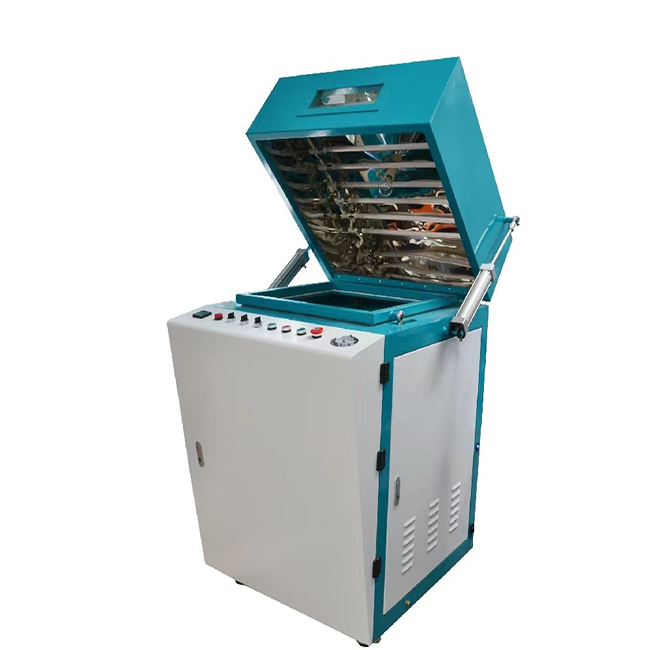
Fully automatic blister machines include automatic molding machines and manual molding. The automated molding machine is suitable for mass production and can automate the entire process from sheet transportation to sheet heating, blister processing, cooling, demoulding, and final product shipping. The automated molding machine has high efficiency, stable product quality, and low worker intensity, but the product size is limited by the machine. When the mold size is smaller than the size specified by the machine, it is necessary to add an additional press frame whose inner hole size is the same as the outer size of the mold and the outer edge size is the same as the machine press frame size, otherwise the remaining sheet material will be increased. The molds used in automated molding machines are mainly steel molds. The artificial forming method is relatively simple. The main equipment is a plate heating drying room, a compressor, a press frame and a mold. After the plate is heated, the plate is taken out and placed on the mold by hand, the edge of the mold is clamped by the pressing frame, and then air is formed. The size of the mold is not limited, as long as there is a large enough drying room. This is the molding method for bus cold air ducts over 7 meters long. The artificial forming method is inefficient and is greatly affected by human factors. Therefore, steel molds are generally not used, and most of them use fiberglass molds.
HUATAO provides blow molding equipment. Including:
Plastic Mold Equipment
Automatic Blow Molding Machine
Semi-automatic Blow Molding Machine
PS Foaming Machine
EPE Foaming Machine
PU Foaming Molded Machine
Horizontal lnjection Molding Machine
vertical lnjection Molding Machine
All-electric Injection Molding Machine
Thick Sheet Blister Machine
Thin Sheet Blister Machine
Color Plastic Masterbatch
Plastic Recycle Machine
Whether you need help with equipment selection, process optimization, or design customization, our team can help. We have the expertise and knowledge to analyze your project needs, identify challenges and develop innovative solutions.